
Move safely through the traffic with a clear head!
Did you know that your air conditioning system can lose up to 10 percent of its refrigerant every year? This not only reduces cooling capacity, but can, in the worst case, cause damage to individual components—and even lead to total failure of the system! Regular maintenance of the air conditioning system helps to ensure that it continues to function smoothly.

An air conditioning check and service can save you money, as any damage can be detected in good time before it causes total failure.

Air conditioning checks and services keep you safe, maintaining a comfortable temperature and allowing you to concentrate fully on the road.

Air conditioning checks and services protect your health, keeping dust, pollen, fungi, and bacteria out of the vehicle interior.
A regularly serviced, properly functioning air conditioning system is also essential for cooling the temperature-sensitive traction battery in electric and hybrid vehicles. Additionally, it extends the traction battery’s service life and improves the vehicle’s cruising range.
Putting health and safety first!
Two issues take center stage in an air conditioning check: health and safety! Scientific studies have shown that our ability to concentrate decreases as temperatures rise, and we tire more quickly. At the same time, our reaction time slows. This significantly increases our risk of having an accident. Vehicle air conditioning systems cool the cabin to a pleasant temperature while dehumidifying the air. This means that the driver’s ability to react and concentrate is maintained over a longer period of time.
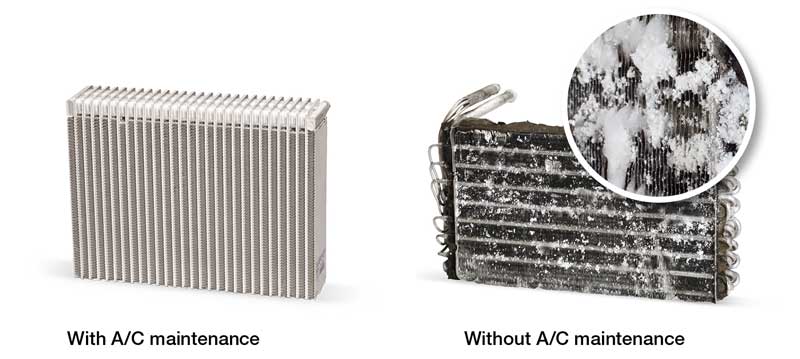
Condensation builds up in the inaccessible, dark, and dank environment between the fins of the evaporator—a breeding ground for bacteria and fungi. That’s why the evaporator is disinfected during an air conditioning check.
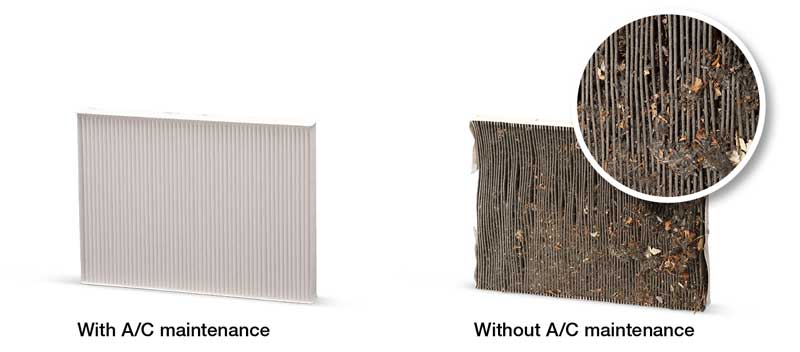
An air conditioning check therefore always includes regular replacement of the cabin filter, which filters dust, pollen, and dirt particles out of the air before they can reach you in the vehicle interior. This improves the air quality and increases safety, as you’re less likely to sneeze while you’re driving!
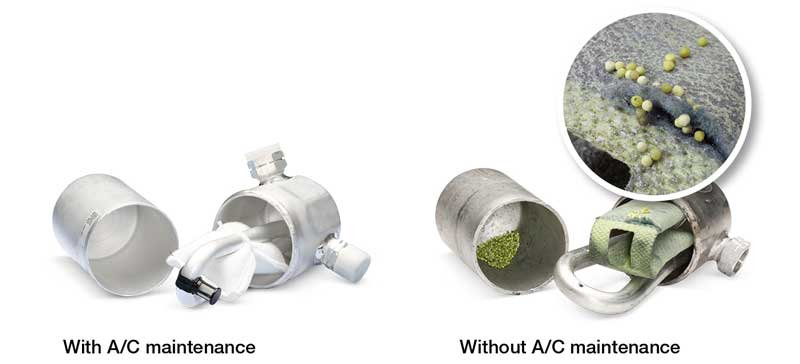
The filter-drier removes dirt particles from the refrigerant and absorbs moisture. But since its capacity is limited, precautionary replacement of the filter-drier is recommended in older vehicles and/or vehicles with high mileage in order to protect the air conditioning system against damage caused by humidity.
How often should I take my car for an A/C check or service?
Set aside a little time for air conditioning maintenance and have your A/C system checked and serviced regularly by a specialist workshop. The following intervals are typical:
Air conditioning check (once a year or every 15,000 km)
- Replacement of the cabin filter
- Visual inspection of all components
- Function and performance test
- Disinfection of evaporator, where necessary
Air conditioning service (every two years)
- Perform all services included in the air conditioning check (see above)
- Replace the filter-drier, where necessary
- Change the refrigerant
- Check leaktightness
- Disinfect the evaporator, where necessary

At a glance: A/C check flyer
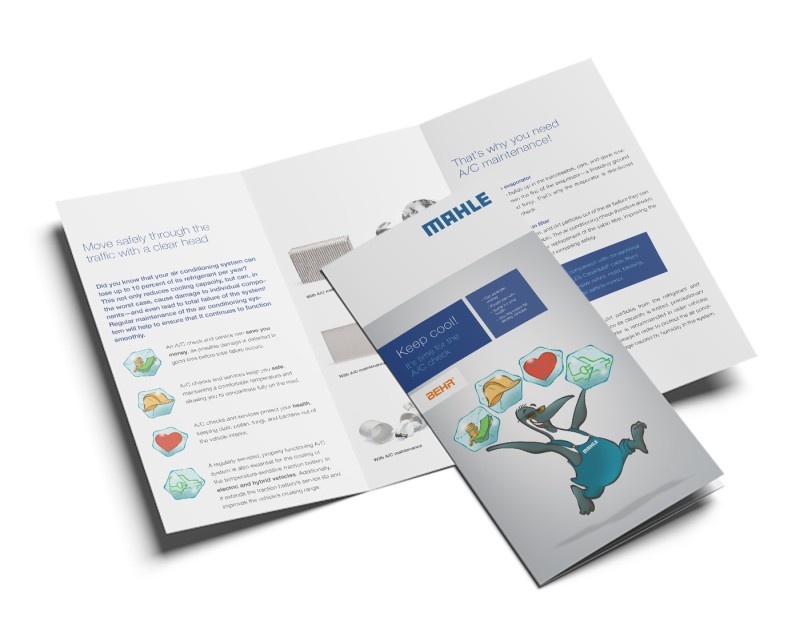
Our flyer about air conditioning checks summarizes everything you need to know about them—and what happens if an air conditioning system isn’t checked regularly.
Download [PDF; 390 KB]
Ole the Penguin explains the importance of regular air conditioning checks

How often should I take my car for an A/C check or service?
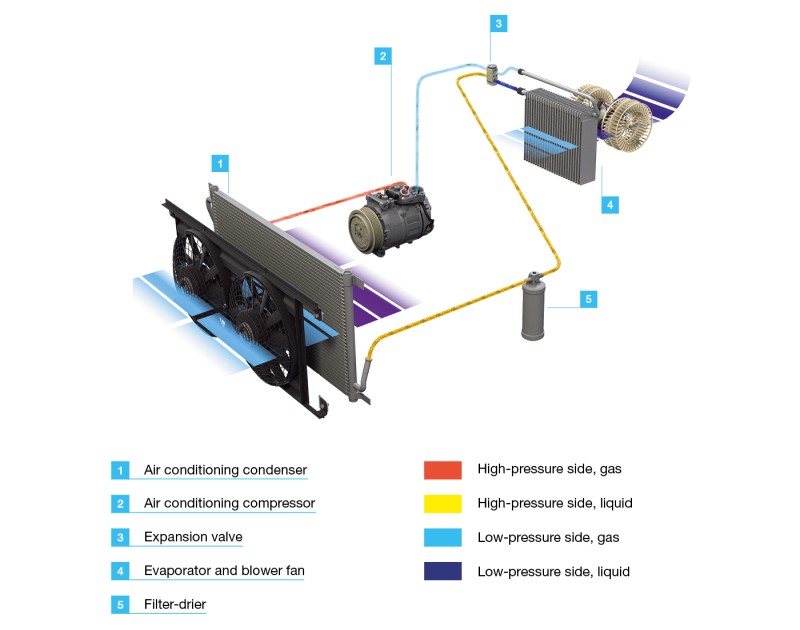
Design of an air conditioning system in a combustion engine
Automotive air conditioning systems work like domestic fridges. In both cases, a compressor pumps refrigerant through a closed system. This extracts heat from the cabin (or fridge) and conducts it outwards.
However, while a fridge has an electrically driven compressor, an automotive air conditioning system is driven mechanically via a V-belt or ribbed belt (except in electric and hybrid vehicles). The individual components in a fridge’s cooling system are close together and usually linked by means of copper pipes with only a few connecting elements with the potential to become loose.
The lines in a vehicle are much longer, and flexible hose lines are used for design reasons. There are many more connecting elements. Very little refrigerant is lost from fridges because they remain in one place, the operating conditions (ambient temperature, air humidity, on and off phases) rarely change, and metal piping is used. Owing to the pipe material and the few connecting elements, very little moisture penetrates into the system. That’s why it’s maintenance-free—unlike an automotive air conditioning system.
Detailed insights into how air conditioning systems work in vehicles with combustion engines can be found in our TechTool.
How A/C systems work in electric vehicles
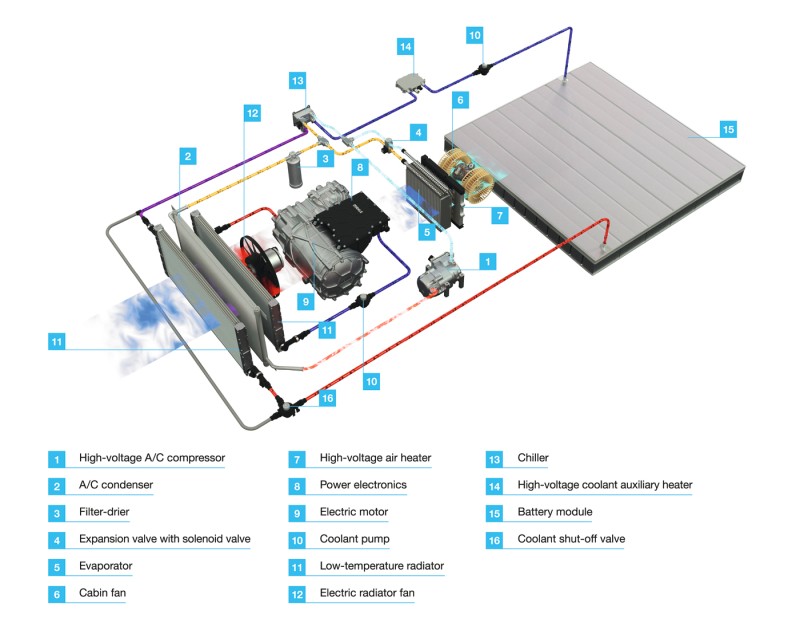
Though the thermal management of combustion engines and electric drives is technically similar, it’s more complex in electric drives. The traction battery, electric motor, and power electronics have different temperature requirements, which must be strictly adhered to. To achieve this, several cooling and refrigerant circuits are required. Optimum temperature control impacts both the service life of these components and the cruising range of electric vehicles. So, in addition to air-conditioning the cabin, the air conditioning system also helps to cool the components crucial to electric drives. It’s clear: a properly functioning and serviced air conditioning system is extremely important!
The more powerful the batteries are, the more complex the coolant- and refrigerant-based circuits need to be. The entire cooling system is subdivided into several circuits, each with its own low-temperature radiator, coolant pump, thermostat, and coolant shut-off valve. The refrigerant circuit for the air conditioning system is integrated via a special heat exchanger (chiller).
The coolant temperature for the electric motor and the power electronics is maintained at below 60°C inside a separate circuit (inner circuit on the figure) using a low-temperature radiator. To achieve maximum performance and ensure the longest possible service life, the battery’s coolant temperature must be kept between approximately 15°C and 35°C at all times.
When temperatures become too low, the coolant is heated via an auxiliary high-voltage heater. When the temperature gets too high, it’s cooled via a low-temperature radiator. If it’s still too hot, the chiller reduces the coolant temperature further. The refrigerant in the air conditioning system flows through the chiller and further cools down the coolant, which also flows through the chiller (indirect battery cooling via the air conditioning system). Everything is controlled with the aid of individual thermostats, sensors, pumps, and valves.
Cooling the battery during fast charging is another important function. Electric vehicles have a charging loss of about 10 percent. Charging losses generate heat in the battery, which has to be dissipated by the cooling system. Since there’s no airstream when charging, the air conditioning compressor is designed to provide the necessary power.
Detailed insights into how air conditioning systems work in electric vehicles can be found in our TechTool.
Additional helpful answers to frequently asked questions about the use and maintenance of automotive air conditioning systems can be found here.
Why do A /C systems need maintenance?
- Up to 10 percent of the refrigerant may be lost each year.
- Otherwise, the oil supply to the air conditioning compressor can be put at risk.
- Moisture in the system can lead to expensive repairs.
Every year, up to 10 percent of the refrigerant may be lost from the system through hoses and connecting elements. This can noticeably impair cooling performance after just three years.
In addition, the refrigerant circulating in the air conditioning system serves as a carrier for the oil that’s also present there. The air conditioning compressor needs this oil for lubrication. If there’s too little refrigerant in the system, the compressor may no longer be adequately lubricated. This can lead to a total failure of the compressor. The necessary repairs may run to up to a thousand euros.
Having the air conditioning system inspected annually can minimize this risk. In addition, refrigerant absorbs moisture from the outside via the system’s hoses. The air conditioning system’s filter-drier can retain some of this moisture. However, it reaches saturation level after around two years of operation. Failure to replace the filterdrier at regular intervals can lead to corrosion due to the high water content in the system.
Excessive wear and mechanical damage to system components are inevitable. There’s also a danger of the expansion valve icing up, which can lead to significant operating problems and even cause the air conditioning system to fail.
The risk of expensive repairs can be minimized by regularly replacing the filter-drier.
Why do A /C systems need regular disinfection?
- Bacteria, fungi, and other micro-organisms that settle on the evaporator can cause musty odors and allergic reactions.
The evaporator is located below the dashboard and is integrated into the ventilation system. This difficult-to-reach area with its dark, dank environment is ideal for bacteria, fungi, and micro-organisms. Dirt particles in the ambient air that collect on the fins of the evaporator provide them with somewhere to settle.
These unwanted pathogens are carried by the ventilation system into every corner of the vehicle cabin. Many people experience allergic reactions (sneezing, coughing, streaming eyes) as a result. These micro-organisms can also cause an unpleasant, musty odor.
Regular disinfection of the evaporator kills off any micro-organisms that may be present. If carried out properly and professionally, disinfection is harmless to human health.
Why does the cabin filter have to be replaced once a year or every 15,000 km?
- Because the flow of air through the cabin filter decreases over time, it needs to be replaced regularly. This is also prescribed by vehicle manufacturers.
- A clogged cabin filter can destroy the blower motor.
- Fogged windows can often be attributed to a clogged filter.
- Unpleasant odors can also originate in the cabin filter.
A cabin filter generally consists of a microfiber mat that filters dust, dirt, and pollen out of the air. Cabin filters containing activated carbon also trap gaseous pollutants (hydrocarbon compounds, ozone). When you consider that up to 300 cubic meters of outside air flow through the filter every hour, you can imagine how the “saturation level” can be reached after a year or 15,000 km. The filter then has to be replaced. If it isn’t, the airflow rate will be reduced. This places a greater load on the interior blower and, in extreme cases, the resulting overheating may even destroy it.
Fogged windows can be a further consequence of a clogged filter, because the air in the cabin becomes too humid. The dirt particles captured by the filter react with the air humidity over time. Odors can also develop in the event of excessive aging of the filter.
Good to know! Compared with conventional cabin filters, MAHLE’s CareMetix® cabin filters ensure that no intense odors, mold, bacteria, or allergens enter the vehicle interior.
Why does the filter-drier have to be replaced?
- The filter-drier removes moisture and dirt particles from the air conditioning system to protect it against damage and optimize its cooling performance.
The air conditioning system’s filter-drier (also called an accumulator, depending on the system) can retain some of this moisture. However, it reaches saturation level after around two years of operation. Failure to replace the filter-drier at regular intervals can lead to corrosion due to the high water content in the system.
Excessive wear and mechanical damage to system components are inevitable. There’s also a danger of the expansion valve icing up, which can lead to significant operating problems and even cause the air conditioning system to fail.
Are there exceptions to the two-year replacement interval for filter-driers/accumulators?
- Vehicle manufacturer doesn’t prescribe replacement, and the vehicle is still under guarantee/warranty.
- The filter-drier and condenser form a fixed unit.
- It would take an excessive amount of time.
- The air conditioning system is leaking.
In a limited number of specific cases, there are exceptions that justify deviation from the twoyear replacement interval for the filter-drier/ accumulator:
If the vehicle is still under the manufacturer’s guarantee/ warranty, and the manufacturer doesn’t prescribe replacement of the filter-drier/accumulator at certain intervals, then there’s no need to replace it during a normal air conditioning service.
However, this decision should be made in consultation with the customer and/or vehicle manufacturer. In a small number of vehicles, the filter-drier and condenser form a fixed unit, which means the filter-drier can’t be taken out and replaced. Given the enormous amount of work and high cost involved, it isn’t absolutely necessary to replace the entire unit every two years.
This also applies to the few vehicle types for which replacing the accumulator/filter-drier would take an excessive amount of time. It’s worth considering and weighing up whether a replacement interval of three or four years might be sufficient in these cases. If it turns out that the air conditioning system is leaking and there’s no refrigerant left in the system, then the filter-drier/accumulator must always be replaced, even if it’s less than two years old. See also “Why does the filter-drier have to be replaced?”
Tip: Replacement of a filter-drier/ accumulator can be delayed by performing an annual, extended evacuation of the system in the “problem cases” outlined above.
What role do A /C systems play in safety?
- Heat is tiring.
- Concentration levels fall.
- Reaction times slow.
- The risk of having an accident increases.
Scientific studies have shown that our ability to concentrate reduces as temperatures rise, and we tire more quickly. At the same time, our reaction times slow. This significantly increases our risk of having an accident. Vehicle air conditioning systems cool the cabin to a pleasant temperature while dehumidifying the air.
Occupants feel comfortable. This means that the driver’s ability to react and concentrate is maintained over a longer period of time.
How does moisture get into the A /C system?
- Hoses are water vapor permeable.
- Most of the oils that circulate through the air conditioning system with the refrigerant are hygroscopic (i.e., they attract water).
Although air conditioning hoses are made up of various layers, they aren’t 100 percent gastight. Just as refrigerant leaks through the hoses to the external air, water vapor (air humidity) penetrates from the outside into the inside through the hose.
The oil that circulates with the refrigerant through the hoses is hygroscopic and attracts moisture.
A /C check/service/maintenance/test—what do all these terms mean?
- In an A /C check or test, certain parameters are inspected without changing the refrigerant.
- An A /C service, or A /C maintenance, involves a complete inspection and includes changing the refrigerant and replacing various parts.
Customers often ask what the difference is between a check, a service, and so on. Although there’s no standard market definition for these terms, a check is effectively the same as a test, and a service is the same as maintenance. A workshop specializing in servicing air conditioning systems, should stick to the following approach:
A check or test should be performed annually. The focus here is on reviewing important parameters, such as high and low pressure and the outlet temperature at the center nozzle. This gives a rough indication of the health of the air conditioning system, and serious defects may be identified immediately.
The cabin filter should always be checked and, if necessary, replaced as well. A check/test also includes a visual inspection of all the air conditioning system’s key and easily accessible components.
Why does the cost of an A /C service differ so much from workshop to workshop?
- Varying scope of work
- Different definitions of what constitutes an air conditioning check, service, etc.
The cost of an air conditioning check or service may differ significantly from workshop to workshop due to the varying scope of the work performed. There’s no standard market definition of what constitutes an air conditioning check, service, maintenance, or test.
This means that some workshops leave out entire process steps, for example, which results in a lower cost. The prices quoted can only be compared if the points covered in the inspection, the work carried out, and any replaced parts are identical.
Why is A /C servicing being pushed so hard? Isn’t this just a money-making ploy?
- Not at all! Experience has shown that regular air conditioning system maintenance can prevent damage—and with it, expensive repairs.
Even just a few years ago, it was thought that air conditioning systems were closed systems that didn’t require any maintenance. However, we now know that possible loss of refrigerant reduces cooling performance—and risks compressor damage. It’s the same story with excessive moisture in the air conditioning system (see also “Why do air conditioning systems need maintenance?”).
On top of that, the investment costs for air conditioning service units and tools have come down significantly over recent years. As a result, it’s become cost-effective for almost all workshops to offer air conditioning servicing and repairs.
Environmental considerations can’t be underestimated either. It’s now well known that the escape of refrigerant due to a defective (leaky) or poorly maintained (excessive fuel consumption) air conditioning system is harmful to the environment.
This has prompted the media as well as the industry and workshops to inform consumers about these issues extensively.
Comprehensive A /C maintenance is recommended every two years. What’s involved?
- The refrigerant is drawn off.
- The filter-drier is replaced (every two years).
- Moisture is removed from the system using a vacuum pump.
- All components are visually inspected, while the connecting and drive elements as well as the cabling and control elements are also checked.
- The air conditioning system is refilled with the vehicle manufacturer’s specified quantity of refrigerant.
- The cabin filter is checked/replaced (once a year or every 15,000 km).
- A performance and leakage test is carried out on the entire system.
- The results of the individual test steps are documented.
How long is an A /C service?
- A normal air conditioning service generallytakes around an hour.
If the customer has raised no particular complaints and the air conditioning system is free of defects, then a service should take around an hour.
What does A /C maintenance cost?
- The cost will depend on the country, region, and local competition.
The workshop also needs to set a competitive price that takes account of its commercial considerations (hourly rate, etc.).
Why is regular A /C maintenance even more important for electric and hybrid vehicles?
In these types of vehicles, controlling the temperature of the battery, power electronics, and electric motor plays just as important a role as the heating and cooling of the cabin. Electric and hybrid drives also require air conditioning components— their importance even increases, since the air conditioning system often has a direct or indirect influence on the cooling of the batteries and electronics.
It’s essential that the batteries used are operated within a defined temperature window. Service life decreases at operating temperatures of 40°C or above, while efficiency drops and output is lower at temperatures below 0°C. Furthermore, the temperature difference between the individual cells must not exceed a particular value. Air conditioning maintenance is therefore set to play an even more significant role in the future.
What’s causing that musty smell in my vehicle?
- The cause might be an excessively aged cabin filter and/or a clogged evaporator.
The dirt particles captured by the cabin filter react with the air humidity over time. Odors can also develop in the event of excessive aging of the filter. Bacteria, fungi, and other micro-organisms that settle on the evaporator can cause musty odors and allergic reactions.
Regular replacement of the cabin filter and regular disinfection of the evaporator can eliminate this problem or even stop it happening in the first place.
For further information, please see “Why do air conditioning systems need regular disinfection?” and “Why does the cabin filter have to be replaced ...?”
Why do my windows fog up? How can I prevent this?
- Fog on windows is nothing more than moisture from the air that settles there.
This can be remedied through targeted use of the air conditioning system.
The air is generally moist at cold and wet times of the year, and we’re always bringing moisture into the vehicle cabin on our clothes, wet shoes, and jackets. This problem is exacerbated by our breathing. Don’t forget the floor mats! They can become small “reservoirs” of water and contribute to further fogging.
The air conditioning system dries the cabin air, thereby defogging windows quickly as well. Select air recirculation mode initially to speed up the process even further.
This can be done in just a few hand movements:
- Switch on the air conditioning.
- Direct the airflow toward the windshield only.
- Press the air recirculation button (in some vehicles, this isn’t possible in combination with point 2—continue to point 4).
- Put the blower and heater on their highest settings.
(After a short time, switch off the air recirculation mode and set the blower to the medium setting.)
Caution! In some models from various manufacturers, the climate control system automatically switches off the air conditioning system when the outside temperature falls below 4°C.
Why should I use the A /C system all year round and not just in the summer?
- To clear fogged windows faster
- For a healthy cabin climate
- To ensure the system still works come the spring
Fogged windows pose a safety hazard. When operating the heating with the air conditioning system running, the air is not only heated but also dried at the same time (more on this under “Why do my windows fog up”?). This creates a healthier cabin climate.
The air conditioning system should be run for a few minutes every week even throughout the winter to ensure that the air conditioning compressor is always supplied with oil and to prevent the seals throughout the system from drying out. This also helps to avoid nasty surprises when trying to turn on the air conditioning system in the spring.
How much extra fuel do A /C systems consume?
- The additional consumption depends on many factors and can be as much as 10 percent.
The amount of extra fuel consumed varies according to the type of air conditioning system, the vehicle’s operating condition, the outside temperature, and the driver’s habits. The level of care and maintenance of the air conditioning system is also a factor. Developments in automotive manufacturing have made great advances here too. For some air conditioning systems with controlled or self-regulating compressors, full power is not always required depending on the operating condition. Many A /C systems now feature automatic temperature control or fully automated control of the temperature and ventilation doors. These further developments play a significant role in keeping extra fuel use to a minimum. The additional consumption is somewhat higher in urban traffic than on freeways or cross-country routes. As the outside temperature increases, greater cooling performance is required of the air conditioning system, which naturally leads to greater fuel consumption as well. Running the air conditioning system throughout an entire journey consumes more fuel than necessary. Thanks to the “postcooling effect,” the air conditioning system can actually be switched off when there a still a few kilometers left to travel (see also “What’s the most effective way to use air conditioning?”). Poorly serviced or unmaintained systems can also be a reason for customers stating that their fuel consumption has increased. When there’s a lack of refrigerant, the air conditioning system’s cooling performance is maintained by the compressor running more often and for longer than normal. It goes without saying that this also increases fuel consumption. Operating an air conditioning system generally increases fuel consumption by 5 to 10 percent. However, this is relative, as we tend to put the windows down and open the sun roof when driving a vehicle without air conditioning in warm weather, which results in almost the same additional consumption due to higher aerodynamic resistance.
How expensive is it to repair a broken A /C system?
- Repair costs of a thousand euros are not unusual in the event of a total failureof the air conditioning system.
Of course, the scale of the repair costs is very much dependent on the nature of the defect, the vehicle type, and the design of the air conditioning system. For example, when replacing an air conditioning compressor showing mechanical damage, the filter-drier and expansion or throttle valve also need to be changed.
To remove all contamination following a mechanical defect in an air conditioning compressor, the entire unit has to be flushed. Otherwise, it can’t be guaranteed that there won’t be another failure after the first repair.
Depending on the vehicle type, replacing an evaporator may involve a considerable amount of labor (dismantling the dashboard) and can also quickly run to a bill of a thousand euros.
How can I tell if there’s a problem with my A /C system?
- Poor cooling performance
- Increased fuel consumption
- Noise development
- Window fogging
- Odor development
These issues may signal an improperly maintained or poorly functioning air conditioning system. A lack of refrigerant can cause unsatisfactory cooling performance (see also “Why do air conditioning systems need maintenance?”).
Increased fuel consumption may result from the air conditioning compressor being run too often and for excessively long periods (see also “How much extra fuel do air conditioning systems consume?”). Noises that can only be heard when the air conditioning system is running are usually caused by the compressor or expansion valve.
Windows that are continuously fogging up are often a sign of a clogged cabin filter (see also “Why do my windows fog up?”).
Musty smells may originate from bacteria or fungi that have settled on the evaporator. It’s even possible that an excessively aged cabin filter is the cause (see also “Why do air conditioning systems need regular disinfection?” and “Why does the cabin filter have to be replaced ...?”). To avoid consequential damage, the air conditioning system should be inspected immediately by a specialized workshop.
How does A /C (a closed system) lose refrigerant?
- Through hoses and connections for the systemcomponents.
A small amount of refrigerant can escape due to “natural evaporation” through the air conditioning system’s hoses and system components with seals. Annually, this can be as much as 10 percent of the total quantity.
The system can’t be completely sealed due to the demands of motor vehicle design (flexible lines, choice of materials).
Why can’t a leaky A /C system simply be refilled?
- Leaked refrigerant is harmful to the environment.
- Leaks must be investigated by law.
- Workshops can be held liable.
If a workshop suspects that the air conditioning system is leaking refrigerant, it can’t simply be topped off. Any newly added refrigerant might escape again immediately.
To protect the environment, the workshop is required by law to carry out a leakage test first and then eliminate any defects. The system may only be refilled following a successful inspection and repair (where necessary). Failure to follow this process is a punishable offence with potentially serious consequences.
Is a refrigerant leak inside the vehicle cabin a health hazard?
- Harm to human health can be virtually ruled out.
Refrigerant escaping into the vehicle cabin is highly unlikely to have an adverse effect on health. If refrigerant gets into the cabin due to a leak (e.g., in the evaporator), this usually happens slowly. Given the constant exchange of fresh air, the refrigerant concentration (% by volume) in the vehicle cabin in the event of a leak is generally classified as low.
It’s only in extremely rare situations, such as when a vehicle’s air recirculation mode is used for a relatively long time and refrigerant escapes all of a sudden, that health problems caused by oxygen deficiency can’t be completely ruled out.
What’s the most effective way to use A /C in the summer?
- Park in the shade.
- Before a journey: leave the doors open for a short while.
- When starting a journey: set the air conditioning system and ventilation to maximum.
- Drive with the windows down and sun roof open for the first few minutes.
- The cabin temperature should not fall below 22°C.
On sunny days, park the vehicle in the shade wherever possible. Otherwise, temperatures within the cabin can reach up to 60°C. To get rid of the heat that has built up in the vehicle, leave the doors open for a short while before getting in.
To cool the vehicle as quickly as possible, run the air conditioning system at full cooling capacity and adjust the cabin fan to the highest setting. The airflow doesn’t have to be aimed directly at the occupants.
Using air recirculation mode for a short period of time will accelerate the cooling process. Leaving the windows and/or sun roof open for the first few minutes of a journey will speed up the air exchange process and therefore cool the cabin faster. But the creation of disruptive air drafts should be avoided. For health reasons, the cabin temperature should not fall below 22°C.
What’s the most effective way to use A /C in the winter?
- Switch on the air conditioning.
- Direct the airflow toward the windshield only.
- Select air recirculation mode (in some vehicles, this isn’t possible in combination with point 2—continue to point 4).
- Put the blower and heater on their highest settings.
For warm, dehumidified air and to clear foggy windows as quickly as possible, the air conditioning system should be turned on before starting a journey, and the airflow directed at the windshield. Temporarily select air recirculation mode to prevent additional humid air entering the vehicle cabin. It’s a good idea to run the interior blower and heating on the highest setting. The air recirculation mode can be switched off again after a short while.
In most cases, it’s enough to leave the interior blower on the medium setting once the fogged windows have cleared. The air conditioning system can then be switched off.
Caution! In some models from various manufacturers, the climate control system automatically switches off the air conditioning system when the outside temperature falls below 4°C. Not all vehicles allow air recirculation mode to be used with the air conditioning system switched on and the airflow directed toward the windshield.
How do automotive A /C systems differ from fridges?
- Mechanically driven compressor
- Number of connecting elements
- Flexible hose lines instead of rigid connections
- Varying operating conditions
Automotive air conditioning systems, like domestic fridges, work on the principle of a heat pump. In both cases, a compressor pumps refrigerant through a closed system. This extracts heat from the cabin (or fridge) to be cooled and conducts it outwards. However, while a fridge has an electrically driven compressor, an automotive air conditioning system is driven mechanically via a V-belt or ribbed belt (except in electric and hybrid vehicles, which also have an electrically driven compressor).
The individual components in a fridge’s cooling system are close together and usually linked by means of copper pipes with only a few connecting elements with the potential to become loose.
The lines in a vehicle are much longer, and flexible hose lines are used for design reasons. There are many more connecting elements. Very little refrigerant is lost from fridges because they remain in one place, the operating conditions (ambient temperature, air humidity, on and off phases) rarely change, and metal piping is used.
Owing to the pipe material and the few connecting elements, very little moisture penetrates into the system. This makes it maintenance-free, although a fridge often contains a drier element as well.